Real Madrid vs Manchester City has become the defining rivalry of the modern Champions League. Yet this season’s meeting arrived under unusual circumstances: both clubs are in transition, both coaches are searching for balance, and both squads were weakened by injuries at the worst possible moment.
Pep Guardiola has spent two years redesigning City’s structure — shifting away from possession-heavy positional play toward a more vertical, dynamic model. Xabi Alonso, meanwhile, is attempting something even more radical: reshaping Madrid into a high-pressing, choreographed system reminiscent of his title-winning Leverkusen. It is a cultural shift as much as a tactical one.
Tuesday night was not just a match — it was a stress test. Who is further in their evolution? Who can compensate for missing stars? And which identity is more stable when the game turns chaotic?
The answer, for now: City. But Madrid are nowhere near broken.
Madrid’s Crisis of Absences: A Defense Held Together by Tape
Real Madrid entered the match with an injury crisis that would cripple almost any elite club.
Out injured: Militão, Heisens, Carvajal, Trent Alexander-Arnold, Mendy.
Unavailable: Mbappé, who felt discomfort the day before and was benched as a precaution.
Alonso had no choice but to improvise:
- Asensio, normally a technical midfielder, paired Rüdiger at center-back.
- The bench included academy names unfamiliar even to many Madrid fans: Martínez, Valdepeñas.
- Up front, Mbappé’s absence meant Gonzalo García, the Club World Cup breakout star, received a shock start.
For a club used to luxury choices, this was survival mode.
City’s Reinvention: A Midfield Rebuilt Without Rodri
City were also without key midfielders: Rodri, Kovacic, Stones. Yet Guardiola’s squad depth — and his recent tactical shift to 4-1-4-1 — allowed him to adapt without collapsing.
The structure:
- Nico González anchored midfield alone.
- Ahead of him, Phil Foden and Bernardo Silva acted as dual creators.
- Guardiola used the same XI for the fifth time this season, a sign he feels close to the balance he has long searched for.
And crucially: City arrived to play on the front foot at the Bernabéu. That alone tells you Guardiola liked what he saw in training.
Early Chaos: Madrid Nearly Strike Twice
Just two minutes in, Madrid nearly earned a penalty.
Bellingham and Gonzalo García pressed Bernardo Silva, Vinícius latched onto the loose ball, cut inside Nunes, and went down under contact. Referee Clément Turpin pointed to the spot — only for VAR to show the foul occurred just outside the penalty area.
Valverde’s free-kick — a rocket — clipped a defender and missed the post by centimeters. City had been warned.
Moments later, Vinícius again broke free after a beautiful pass from Rodrygo. He lifted the ball over Donnarumma but narrowly missed. Madrid were electric in transition, exactly as Alonso had planned.
City Take Control, But Madrid Strike First
After the early scare, City stabilized, holding possession and forcing Madrid deeper and deeper. But the tempo slowed. The visitors moved the ball patiently yet rarely entered the box — stuck in Madrid’s midfield web.
Then came the breakthrough.
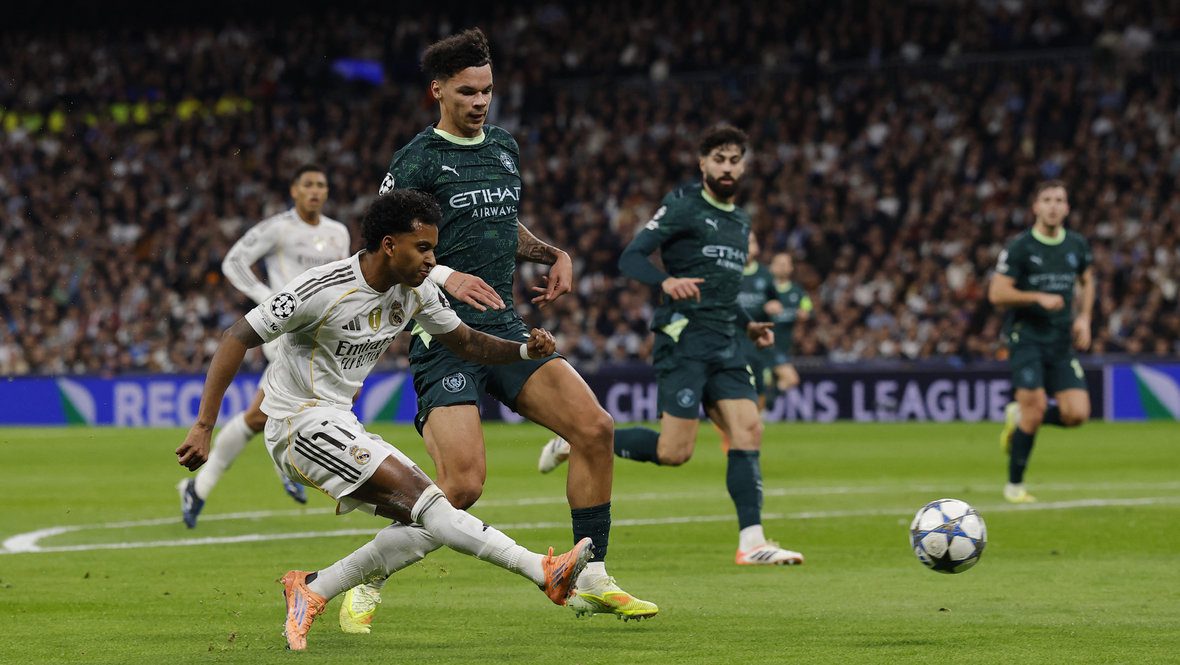
In the 28th minute, after Bernardo lost the ball in buildup yet again, Madrid launched a fast counter. Bellingham slipped Rodrygo through, and the Brazilian fired under Donnarumma’s leg.
It was his first goal in 33 matches — a moment of catharsis.
For a brief spell, the Bernabéu believed.
City’s Response: Two Blows in Five Minutes
Champions respond quickly, and City did.
1. The Corner Equalizer
From a set piece, Guardiola outjumped Bellingham and forced a save from Courtois. O’Riley pounced on the rebound.
1–1, and Madrid’s defensive patchwork began to show its limits.
2. The Penalty
Five minutes later, Rüdiger mistimed his tackle and brought down Erling Haaland. The Norwegian, cold as steel, converted with ease.
Suddenly, Madrid were drowning.
Courtois produced a breathtaking double save — first stopping Haaland, then Sherki — to keep the score at 1–2.
For Madrid, it could have been 1–4 by halftime.
The Second Half: Fireworks in Both Directions
The second half felt like pure Champions League chaos — structure dissolving, space opening, momentum swinging like a pendulum.
City Attack Through Doku
Guardiola focused his attack through Jérémy Doku, who repeatedly isolated defenders and created danger. Courtois again delivered:
- A full-stretch save on Sherki.
- A fingertip stop on Doku’s curling effort.
It was a heroic performance despite conceding twice.
Madrid Still Had Their Moments
Madrid’s threat came exactly as Alonso envisioned: explosive counters launched by Carreras.
- Bellingham attempted a delicate chip over the keeper — inches wide.
- At 80’, substitute Endrick entered, and Madrid went all-out attack.
- Vinícius received a perfect far-post ball but couldn’t adjust his body and sent the shot over.
Bernabéu turned into a cauldron. Even without Mbappé, Madrid created enough to equalize.
In stoppage time, they pinned City inside the box — wave after wave — but never broke through.
Should Alonso Be Under Pressure? Absolutely Not.
The final score: Real Madrid 1–2 Manchester City.
But this is not the type of defeat that warrants panic — or dismissal.
Alonso’s Madrid:
- Created multiple high-quality chances against an elite defensive side.
- Played with clear structure despite missing most of their back line.
- Showed bravery, identity, and adaptability.
- Demonstrated that once key players return, the ceiling is extremely high.
Rumors of a “win-or-be-fired” ultimatum should stay rumors. Alonso’s work is evident. This team has a future — a strong one — but it will take time.
Five Clubs Already Qualified for the Champions League Playoffs
Matchday 6 of the Champions League league phase confirmed the first five teams guaranteed to reach the knockout stage:
- Arsenal
- Bayern Munich
- Paris Saint-Germain
- Manchester City
- Atalanta
All five will play at least in the playoff round (1/16 final), while teams finishing 1st to 8th after Matchdays 7–8 will advance directly to the Round of 16.
The final two matchdays of the league phase take place in January 2026, with 24 teams still battling for their postseason futures.