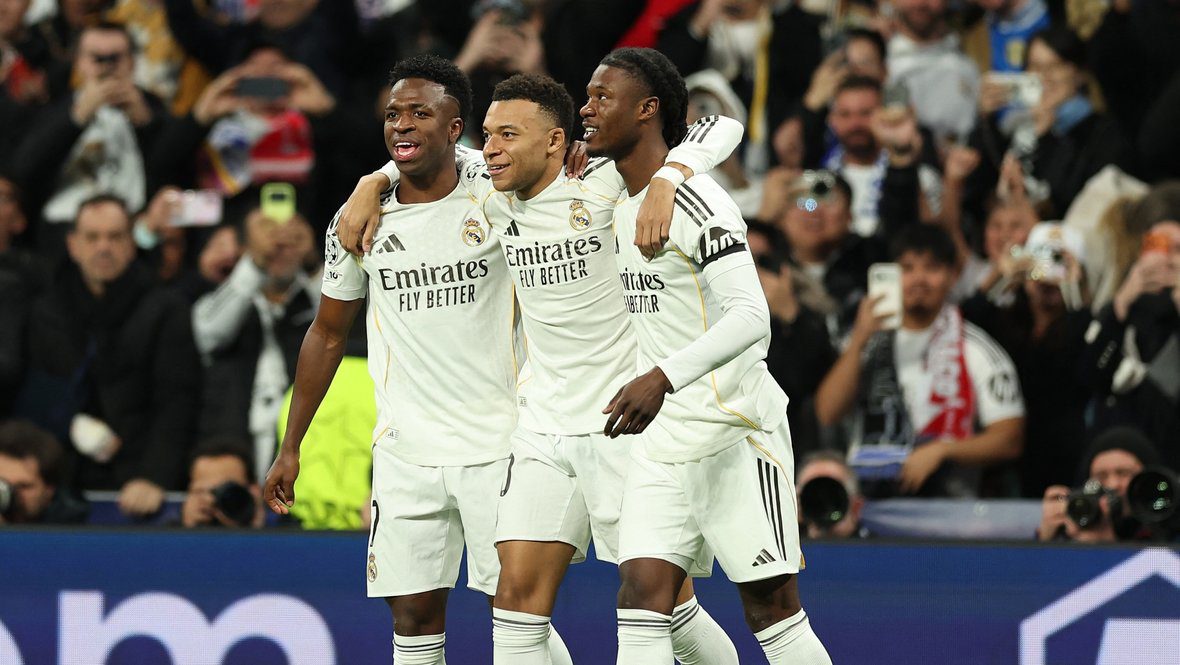
Real Madrid delivered a ruthless Champions League performance at the Santiago Bernabéu, crushing AS Monaco 6–1 on a night marked by national mourning in Spain. Kylian Mbappé and Vinícius Júnior led the demolition, while Aleksandr Golovin showed composure and quality despite Monaco’s collective collapse.
The Santiago Bernabéu has witnessed countless iconic European nights, but this one carried a different emotional weight. Just hours earlier, Spain was still absorbing the shock of a tragic train accident in Andalusia that claimed dozens of lives. Despite a national period of mourning, UEFA confirmed that Champions League fixtures would go ahead as scheduled. Before kickoff, the stadium observed a minute of silence, with players from both teams gathering around the center circle as messages of remembrance appeared on the screens. Football, once again, became both a distraction and a release — a familiar ritual in moments of collective grief.
Against this backdrop, Real Madrid and AS Monaco arrived with very different forms of tension. Monaco traveled to Madrid in alarming domestic shape, having lost eight of their previous nine Ligue 1 matches. Their Champions League campaign had offered occasional bright spots, but confidence was fragile. Head coach Sébastien Pocognoli had taken responsibility publicly, while club owner Dmitry Rybolovlev cut a visibly concerned figure during the pre-match training session. There was a sense that Monaco were bracing themselves rather than believing.
Real Madrid, meanwhile, were navigating their own instability. Recent weeks had brought managerial change, internal scrutiny, and an unexpected Copa del Rey exit. Álvaro Arbeloa’s early days in charge were being closely watched, and the Bernabéu crowd had not been shy in expressing frustration earlier in the month. This match, then, was not just about points — it was about restoring authority and confidence.
That intent became clear almost immediately. Madrid started with intensity and precision, and Kylian Mbappé wasted no time reminding his former club of his elite instincts. He opened the scoring early, showing sharp movement and ruthless efficiency. Vinícius Júnior soon followed with a decisive contribution, bursting past defenders and providing the assist for Madrid’s second goal. Within half an hour, Monaco were already chasing the game in a stadium that punishes hesitation.
To their credit, Monaco did not collapse straight away. The first half remained surprisingly open. They created chances, struck the crossbar, and forced Thibaut Courtois into several important saves. Aleksandr Golovin was central to Monaco’s attacking structure, dropping deep to link play and driving forward whenever space appeared. His composure and decision-making stood out, even as Madrid’s pace and quality loomed constantly on the counter.
The turning point arrived early in the second half. A flowing Madrid move ended with a goal from teenage midfielder Franco Mastantuono, one of Arbeloa’s notable selections. That strike broke Monaco’s resistance. From that moment on, the match tilted entirely in Madrid’s favor, both physically and psychologically. Space opened up, pressure intensified, and mistakes multiplied.
Vinícius Júnior, who had been under scrutiny in recent weeks, delivered a performance that felt both expressive and symbolic. After assisting twice, he scored himself with a spectacular finish under the crossbar. His celebration — sprinting straight toward Arbeloa on the touchline — spoke volumes. It was a public endorsement, a release of tension, and a reminder of how quickly narratives can shift at this level.
Monaco managed to pull one goal back after a defensive error, but it did little to alter the flow. Madrid continued to press, exploiting every gap with clinical efficiency. The final scoreline — 6–1 — reflected not just individual brilliance, but the complete collapse of Monaco’s structure once belief evaporated.
Despite the heavy defeat, Aleksandr Golovin emerged with credit. On one of football’s most demanding stages, he remained composed, active, and willing to take responsibility. He continued to ask for the ball even as the score worsened, attempting to impose control where little remained. After the match, his brief remarks were professional and measured, betraying disappointment but also experience — the mark of a player accustomed to elite competition.
For Real Madrid, the victory offered more than three points. It restored momentum after weeks of uncertainty and reinforced trust in Arbeloa’s early decisions. Whether this performance represents a true turning point or simply the perfect response against a struggling opponent will become clearer in upcoming fixtures, starting with a challenging away match at Villarreal.
For Monaco, the result deepened an already troubling trend. Structural issues, fragile confidence, and unanswered questions about direction remain. In the unforgiving environment of the Champions League, such weaknesses are exposed mercilessly.
European nights rarely allow for excuses. At the Bernabéu, football resumed amid sorrow, delivered spectacle, and reminded everyone why this competition remains the most demanding stage in club football.