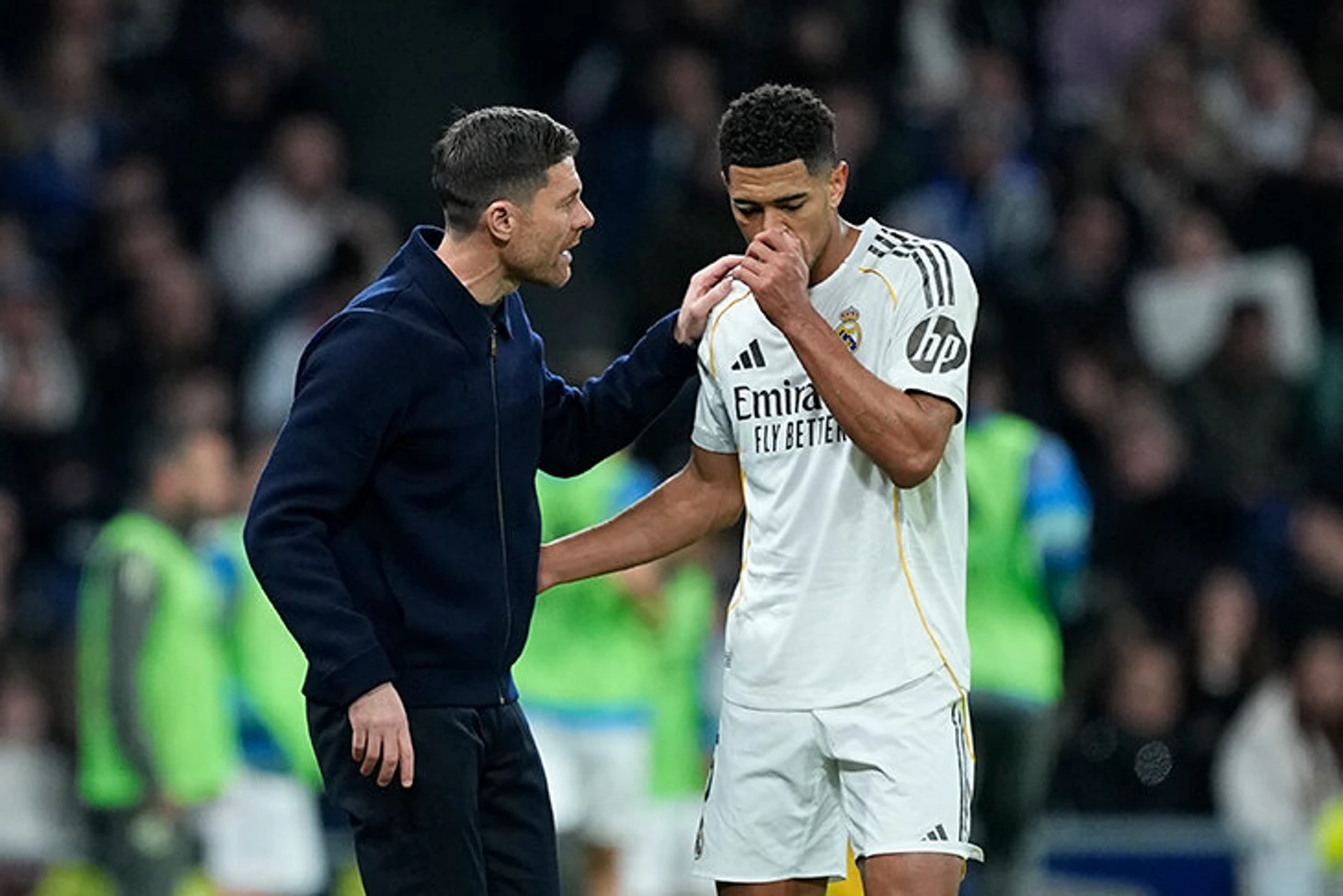
Real Madrid’s dismissal of Xabi Alonso has sent shockwaves through European football. What was framed as a mutual decision now looks like a structural failure that cost the club a rare opportunity to modernize and build a sustainable future in line with today’s Champions League elite.
A Sudden Exit That Raised More Questions Than Answers
Real Madrid officially announced that Xabi Alonso had left his role as head coach by mutual agreement, with Álvaro Arbeloa immediately promoted from Castilla. The language of the statement was calm and diplomatic, clearly designed to limit fallout and speculation. Yet within hours, conflicting reports emerged, painting a far more complex and troubling picture behind the scenes.
Some sources suggested Alonso chose to step away, exhausted by constant pressure and a lack of institutional backing. Others claimed the club lost faith in his methods, citing inconsistent results, tactical uncertainty, and tension with key players. Regardless of which version is closer to the truth, the outcome reflects poorly on Real Madrid. A project built around one of Europe’s most promising young coaches collapsed before it was given real time to develop.
A Club Unready for Structural Change
Alonso was appointed to lead a philosophical shift. He arrived with a clear vision centered on structure, automation, positional discipline, and modern pressing principles. This was not cosmetic change, but a fundamental attempt to move Real Madrid closer to the models dominating the Champions League in recent years.
The problem was not the ideas themselves, but the environment in which they were introduced. Real Madrid has long thrived on individuality, improvisation, and star autonomy. That culture, shaped by the success of coaches like Zidane and Ancelotti, proved resistant to rigid systems and collective algorithms. Alonso found himself forced into compromise, gradually losing authority as he tried to balance his principles with dressing-room realities.
Dressing Room Resistance and Silent Power Struggles
According to multiple Spanish outlets, tensions between Alonso and the squad began as early as the Club World Cup. The breaking point reportedly came after a high-profile substitution involving Vinícius Jr. in El Clásico, which intensified internal friction. From that moment, Alonso increasingly retreated from his core ideas in order to maintain control.
Key figures struggled to adapt to the demands of his system. Alonso envisioned an aggressive pressing structure, but Kylian Mbappé was unwilling to operate at that intensity. Vinícius, Jude Bellingham, and Federico Valverde were unable—or unwilling—to reshape their roles to accommodate Mbappé’s limitations. The result was a tactical stalemate that left Alonso feeling trapped in a cycle with no viable solutions.
Lack of Institutional Protection
Perhaps the most damaging element was the absence of clear support from above. Alonso was formally the head coach, but never enjoyed the authority required to enforce change. Club insiders report that Florentino Pérez did not publicly defend the project, allowing pressure to build through leaks, rumors, and constant speculation about Alonso’s future.
Each match became an unofficial referendum. A draw or defeat triggered fresh reports of potential dismissal, creating an atmosphere in which long-term planning became impossible. In such conditions, coaches stop building and start surviving. Alonso became a convenient scapegoat for deeper structural contradictions the club was unwilling to confront.
Results Were Not the Real Issue
From a sporting perspective, the dismissal is difficult to justify. Under Alonso, Real Madrid were on course for a top-eight finish in the Champions League league phase—something the club failed to achieve in Carlo Ancelotti’s final season. Domestically, they remained within touching distance of Barcelona despite instability and adaptation pains.
Crucially, Alonso was never given enough time to either succeed fully or fail definitively. The project ended before half a season had passed, turning the entire experiment into a theoretical “what if.” Even critics must acknowledge that sustainable systems are not built in a matter of months.
Players Did Not Expect the Decision
Reports from Marca indicate that the squad was stunned by Alonso’s departure. Players learned of the decision through the official announcement and did not anticipate an immediate change. In recent weeks, relationships inside the dressing room had reportedly stabilized, with Alonso regaining trust and improving communication.
Kylian Mbappé was among the first to publicly respond, thanking Alonso for his trust and describing him as a coach with clear ideas and deep football knowledge. The message made one thing clear: even those who struggled under his system did not expect his exit to come so abruptly.
Real Madrid’s Retreat to Familiar Patterns
With Arbeloa stepping in, early reports suggest a return to a looser, Ancelotti-style model, prioritizing player freedom over tactical rigidity. From an institutional perspective, this represents a retreat rather than progression. Real Madrid chose comfort over transformation, tradition over adaptation.
This decision raises a fundamental question: does Real Madrid actually want to become a “normal” modern football club, built on structure and process? Or is it content relying on aura, elite talent, and moments of brilliance, even as European football evolves around it?
Why This Matters for the Champions League Landscape
Real Madrid’s choice has implications far beyond La Liga. At a time when Champions League contenders are increasingly defined by systems, depth, and institutional alignment, Madrid rejected a path toward modernization. Alonso’s dismissal signals that even Europe’s biggest club struggles to reconcile legacy with progress.
Whether this decision proves correct will only be clear in time. What is certain is that Real Madrid closed the door on a future that could have aligned them more closely with the sport’s prevailing trends. The clouds gathering over the Santiago Bernabéu may not be stopped by a retractable roof.
For more Champions League news tailored for Indonesia, read the latest updates here. To explore recent results, standings, and the wider European football picture, you can check them here.